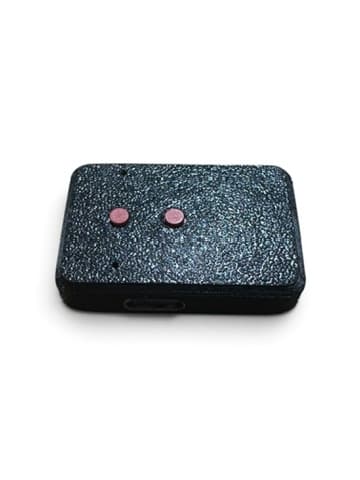
Before the first iteration
Starting with a XIAO
My first proof of concept used an off-the-shelf XIAO board in a custom black 3D-printed enclosure. The module was compatible with standard 18mm watch bands, giving the early build a wrist-worn form.
In progress
An IMU-only wearable for gesture input, developed from a XIAO proof of concept and an early custom board that explored biopotential sensing.
A wrist-worn device that explores using hand movements as input. Its motion sensor measures movement instead of reading muscle signals.
I’m developing the circuit boards and wearable packaging, starting with a ready-made board before moving to custom hardware.
The current board focuses on movement sensing. Gesture-recognition performance is still being developed and documented.
The current wearable uses an inertial measurement unit (IMU) for gesture input. Its sensing is based on movement. Biopotential sensing was an experiment in the first custom-board iteration.
Before the first iteration
My first proof of concept used an off-the-shelf XIAO board in a custom black 3D-printed enclosure. The module was compatible with standard 18mm watch bands, giving the early build a wrist-worn form.
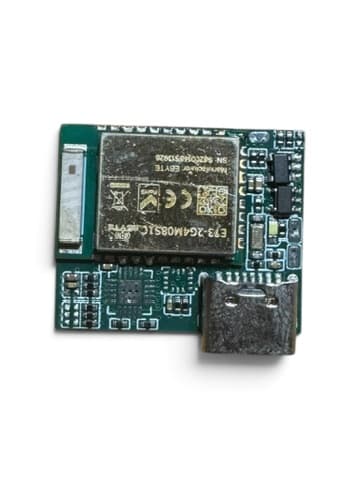
First iteration · AD8232 experiment
The first iteration attempted to integrate biopotential signals alongside motion sensing using an AD8232. The board photo documents this early hardware experiment.
The current wearable takes an IMU-only approach. The AD8232 design is part of the project’s development history.
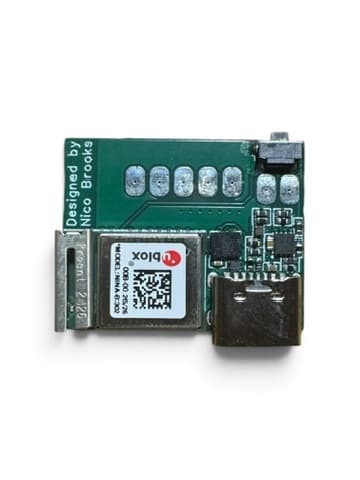
Current iteration · PCB v2
The current iteration focuses on IMU-based gesture input. PCB v2 uses an LSM6DSV16X motion sensor and a NINA-B302 module for the IMU-only design.
The board photo documents this revision, following the earlier AD8232 experiment.
The system overview below explains the project at a high level. Detailed design files are shared selectively. For a technical review or collaboration, get in touch to discuss access.
Current IMU-only hardware. Gesture recognition and its performance remain in development.
Motion sensing
Supporting hardware
Explore another build
Ergo Glass