Technical notes · In progress
Gesture Wearable
The current IMU-only design and the early hardware experiments that preceded it.
Current Design
The gesture wearable is IMU-only. An inertial measurement unit provides motion sensing for gesture input. The AD8232 biopotential circuitry belongs to the first custom-board iteration, rather than the current design.
System Overview
System overviewBlock diagram
Current IMU-only hardware. Gesture recognition and its performance remain in development.
Motion sensing
- Wrist movementThe physical gesture
- IMULSM6DSV16X · motion measurements
- Embedded processingNINA-B302 · developing gesture input
Supporting hardware
- Battery + USB-CPower and a wired connection
- Wearable electronicsCustom board with a physical button input
- RGB LEDVisual feedback
Intended gesture flowFlow chart
- 01Move your wrist
- 02Measure motion
- 03Recognize a gesture
- 04Produce an input
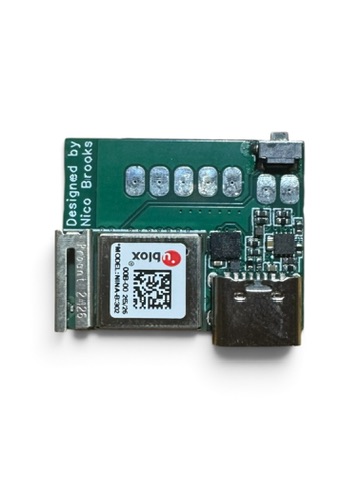
Current Hardware · PCB v2
The current board uses an LSM6DSV16X IMU and a NINA-B302 module, with USB-C, battery power circuitry, a button, and an RGB LED. This revision uses IMU-only sensing.
First Proof of Concept
Before the first iteration, I used an off-the-shelf XIAO board in a custom black 3D-printed enclosure. The module was compatible with standard 18mm watch bands.
See the XIAO proof of concept.
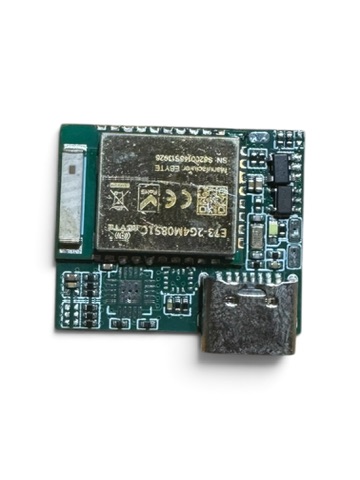
First Custom-Board Iteration
The initial custom-board design attempted to integrate biopotential signals alongside motion sensing using an AD8232. The board photo documents this earlier experiment.
View the hardware development gallery.
Design Documentation
Detailed schematics and PCB layouts are shared selectively. These public notes cover the hardware approach and development history. Get in touch for a technical review or collaboration.
Development Status
The project remains in progress. These notes describe the current sensing approach and the early prototypes; gesture-recognition performance is still to be documented.